
Skip to content
← Home
Innovation · what's actually under the hood

Ask RIVET runs entirely on your machine.

No account. No cloud. No telemetry. That is the whole product position, and it is easy to claim — so everything on this page is the evidence for it: the model, the runtime, the numbers, and what happens on the wire.

Model
Qwen3-1.7B
Runtime
llama.cpp
Cloud calls
0
Accounts
None
local inference fetched, not bundled every action reversible no analytics SDK signed MSIX
01 · On-device AI

Specifics, not adjectives.

"Advanced AI" is worth nothing as a claim. Here is the whole stack, named, so you can verify it yourself — check the process list, check the firewall, check the folder.

The stackverifiable
model
Qwen3-1.7B (instruct)
runtime
LLamaSharp → llama.cpp
format
GGUF, 4-bit quantised
download
≈1.1 GB · on demand
memory while running
≈2 GB RAM
execution
CPU, in-process
network after download
none
alternative endpoint
Ollama on localhost

Fetched, not bundled

Shipping a gigabyte of model weights inside a system utility would be indefensible. The installer stays small; the model is downloaded once, only if you open Ask, and only after you say yes. Never touch the feature and it is never fetched.

One request, ever

That download is the only outbound connection RIVET makes in its lifetime. After it lands, inference happens in-process on your CPU. Pull the network cable and Ask keeps answering.

Or bring your own

Already running Ollama? Point Ask at localhost and it uses whatever you have loaded instead. With nothing listening and no model downloaded, it falls back to a knowledge base compiled into the app — so the feature never dead-ends.

→ Every path and key, documented
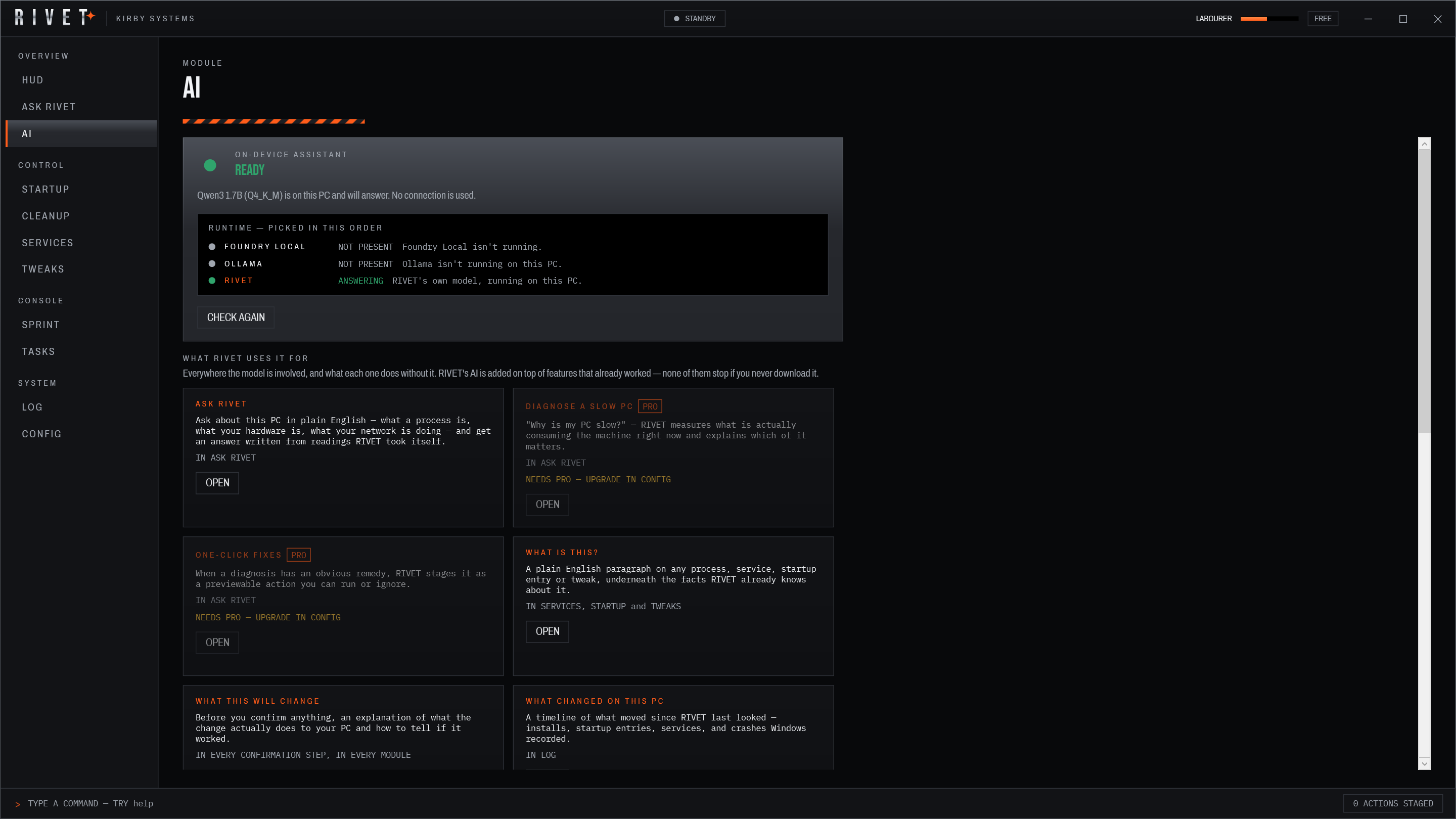
Ask RIVET answering a question about the machine's state, with the on-device model named in the panel header.
Ask RIVET, answering with the network down
02 · Architecture

An action is an object
that knows its own undo.

Most tuning utilities fire a command and hope. In RIVET nothing executes directly. Every change — a killed process group, a disabled startup entry, a stopped service, a registry tweak, an emptied folder — is constructed as a reversible action first, and that object is what runs.

STEP 01

Capture the prior state

Before anything is written, the action records what is there now — the registry value, the service start type, the file location. The undo is built before the change is.

STEP 02

Preview, then confirm

You see the exact set of changes staged before they run. Cleanup reports per-row sizes and waits. Nothing is silent, and nothing runs on a schedule you did not set.

STEP 03

Take a net first

System-level tweaks create a restore point before applying. Deletions route through the Recycle Bin rather than straight out. Elevation is requested per action, not held.

STEP 04

Execute and log

The action runs and writes itself to the log with a timestamp, the target, the prior value and the method that reverses it. The log persists between sessions.

STEP 05

Revert any entry, any time

Not just the last one. Because every entry carries its own undo, you can reverse a change from three weeks ago without touching the ones after it.

WHY

It changes what you'll try

The point isn't the undo button. It's that a tool you can't break is a tool you'll actually experiment with — which is where the performance you were looking for was hiding.

03 · How it's built

From one .ps1 file
to a signed package.

RIVET started as a single PowerShell script that drew a HUD in a console window. Everything it does today it earned by being rewritten — three times.

2024 · v1

A script for one machine

Written to stop retyping the same maintenance commands. Console output, no UI, no state.

2025 · v2.1

35 verbs and a data folder

Still one file, but with a drawn HUD, typed commands, tasks and a rank ladder persisted under C:\rivet\. It sold on itch.io and hit the ceiling of what a script can be.

2026 · v3.3.2

A compiled desktop app

WPF on .NET 10, one signed MSIX on the Microsoft Store. Eleven modules behind a sidebar, an action log underneath all of them, and an assistant that reads live system state.

What the rewrite bought

countersCIM + performance counters
processesgrouped, act on a whole tree
startupmeasured boot impact
servicesstate + start type, writable
binariessignature checked
distributionsigned MSIX, Store certified
prerequisitesnone — runtime is in the package

Not screen-scraped command output dressed up as a UI. The app talks to Windows through the interfaces Windows provides, which is the only reason the undo can be trusted.

04 · Why there's no telemetry

A tool with root on your PC has to be boring about data.

RIVET can read your process tree, your installed software, your startup entries and your disk. Any usage analytics collected from a program with that reach would be worth a great deal to somebody, which is exactly why there aren't any. There is no analytics SDK in the package, no crash reporter phoning home, no unique install ID, and no server on the other end to receive any of it.

The cost

We're flying blind, deliberately

No idea which module you use most. Features get built from what people write in, not from a dashboard. That is slower, and it is the trade we chose.

The only files

Your data folder, and that's it

Tasks, log, settings and progression live in your own profile in plain files. Delete the folder and RIVET forgets everything. Nothing is mirrored elsewhere.

Check it

Don't take our word for it

Block RIVET at the firewall and use it for a week. Nothing degrades except the one-time model download. The technical notes list every path and key it touches.

Everything above runs
on your own hardware.

The trial is the whole app, and the fastest way to check any of these claims is to watch it in Task Manager yourself.

▸ Get RIVET — free
Microsoft Store·v3.3.2 · 12 Aug 2026·Changelog
RIVET v3.3.2 Free trial · no account
▸ Get it free